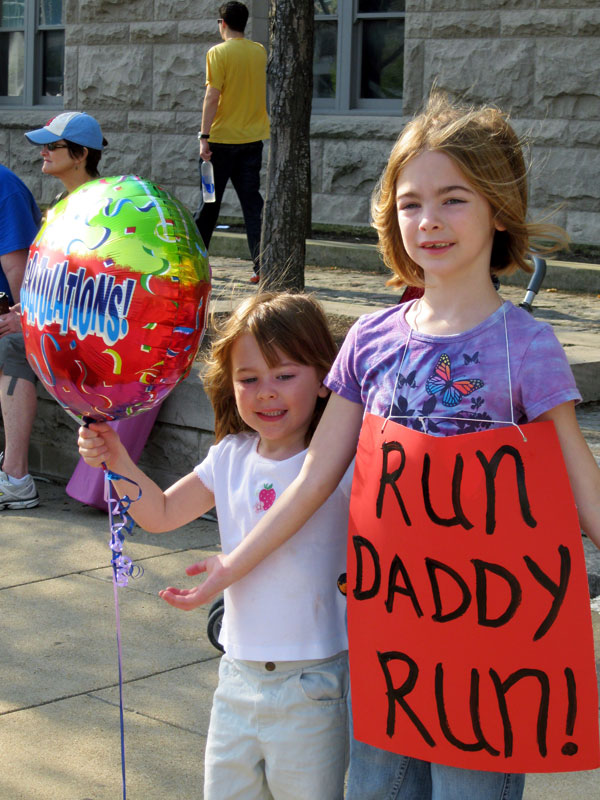
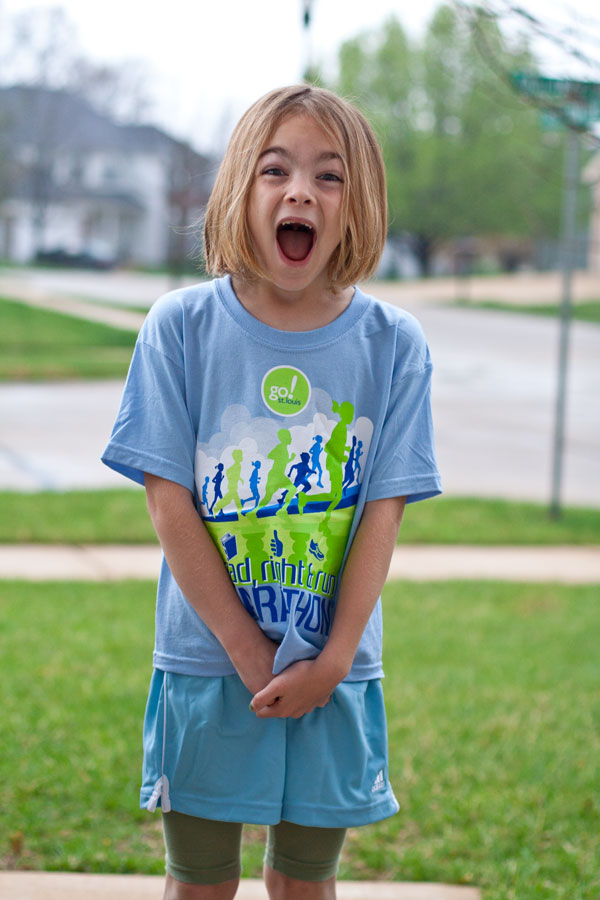
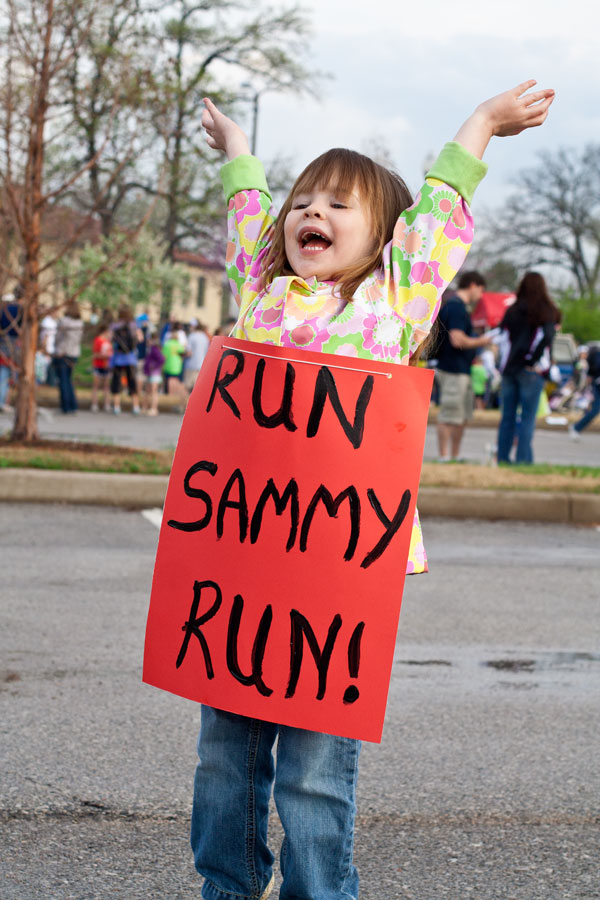
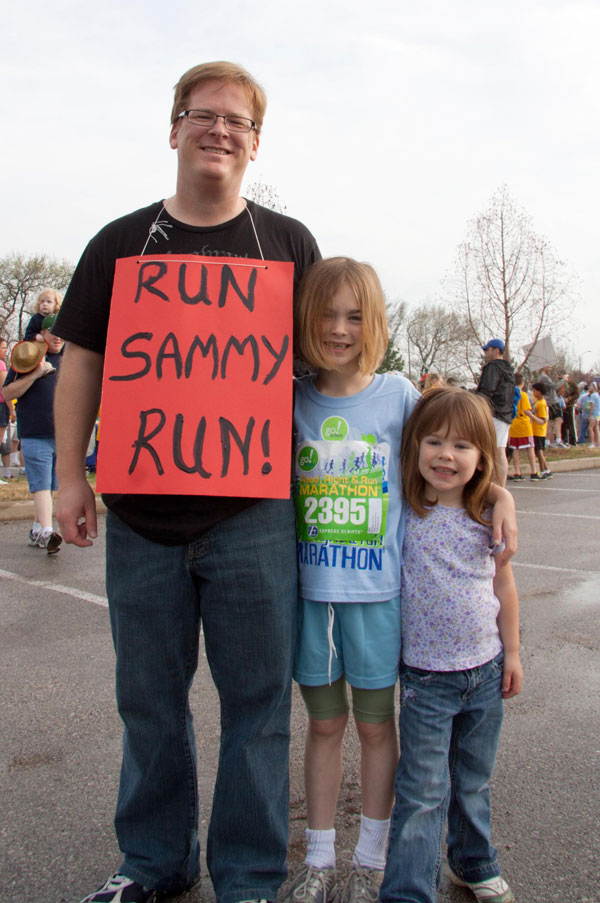
Mandy finally got her cast off earlier this week, and I'll let you in on a little secret: small children are terrified by strange men attacking their leg with huge (relatively speaking) buzzsaws. Fortunately the ordeal passed quickly, and we now have the cast sans Mandy for a souvenir. Mandy seems happy to be without it, but she still kind of drags her right foot a little and points it outwards more than she should like some kind of extra in a zombie flick taking place entirely in a nursery. The doctor says that will correct itself, though, so we only have a limited amount of time to finish filming.
That was really the least of our worries upon returning home from the doctor's office, though. While there, he poked Mandy a few times and pronounced that she had a "shallow hip" and that we should do something about that if we wanted to avoid surgery in the next few years.
Now, if you're a parent, you may have some idea of the reaction this got from us, especially if your child has ever been diagnosed with anything more than a mild fever. Really, there is absolutely no middle ground on the Continuum of Parental Concern --everything pretty much occupies the extreme poles, as shown in this xkcd style graph:

The doctor assured us (or rather, Ger, since I was blissfully grinding away at work) that the treatment was simple, though: six months of strapping Mandy down into this brace like a slightly inept and very gender confused James Bond every time she goes down for a nap or sleep. The doctor mumbled something about how some babies take to it just fine, while others get "slightly aggravated." The nurse standing behind the doctor reportedly rolled her eyes at this, presumably because she knew that once again it's all about the extremes, and toddlers don't get "slightly" annoyed any more than one could get a slightly gargantuan or a little bit frenzied.
Fortunately Mandy once again proved herself worth of the "World's Mellowest Baby" award and protests not a bit when we strap her in. In fact, through some kind of Pavlovian conditioning, she has actually started to smile and giggle when we pull out the brace, paired as it is with perusing a few books and lying down for a snooze. She's so awesome.
Sam is also awesome, but for different reasons. It seems that whatever clock is ticking away insider he has decided that it's time to really get on board with this whole numbers thing, so that she is constantly counting things. Leaves, people, fork tines, fingers, dogs, cars --whatever. Or sometimes she gives the things a break and just counts to herself. She's mastered the concept of a base ten number system, because after getting over the stumbling block of the teens she has figured out how to just keep going. The other day while we were driving in the car, for example, she counted aloud from 1 up to 78 before getting bored of it. She has also started to wrap her head around basic subtraction and addition, as evidenced by how I've spied her with her head bent over a pile of Cheerios, moving one or two in or out of the pile at a time and muttering to herself as she revised her tallies.
And, come to think of it, she seems to be hitting the same milestone with letters and words. She expresses lots of curiosity about what words say, and the other day when she was on the floor playing with some toy letters she commanded me to "look LOOK" at something she had done. There on the floor were the letters "S-A-M-M-Y." So she had either spelled her first word all by herself or just thrown the the whole alphabet of letters up into the air and gotten VERY lucky.
Comments (4) |
Permalink |
File under: Parenting
Tags: Amanda, Mathematics, Parenting, Samantha
Book Review: Gardens of the Moon May 9, 2008
Note: This is book #22 in my 52 Books in 52 Weeks challenge for 2008.
Gardens of the Moon is the first in Steven Erikson's gargantuan and oddly named fantasy series, Malazan Book of the Fallen. What's odd about it is that it took me THREE tries to get through this first volume. The first two times I tried, I got one or two hundred pages in and just lost interest, mainly because I was confused and didn't know what was going on. But the third time I tried it just clicked and I enjoyed it. Figuring out why this is the case took some thought, and I believe it boils down to two basic and interconnected reasons.
First, Erikson has an extreme "show, don't tell" kind of style. The very first chapter dumps you head over heels into the middle of an epic storyline full of action, with hardly any exposition at all. There's no narrator saying "Okay, there's this nation called the Malazan Empire, and they've been engaging in a protracted military campaign against a group of allied Free Cities. We're going to enter the story as the Malazan forces prepare to attack one of these cities, which has formed an alliance with this one badass dude who controls a flying fortress. Now, let's talk about the structure of the Malazan military..."
No, none of that. Instead, after a brief prologue where you eavesdrop on a few characters, you get action action action and you're left to yourself to figure it all out by paying close attention and making your own inferences based on what's said and done. This is mainly what put me way off balance on my first two attempts at reading this tome.
The offsetting effects of show-don't-tell style are exacerbated by something else Erikson does: he eschews many of the typical fantasy staples that usually act as guideposts to new readers. There's a reason why not many books stray from the formula of a hapless youngster being apprenticed to an elder wizard or military veteran or adventurer or whatever who guides him through the world that has been opened up to both him and the reader. It allows the author to slyly provide exposition about the world by having the master explain things to the apprentice while the reader just sort of listens in. And going along with all that, other fantasy staples act as familiar sign posts and landmarks so that you don't get lost.
Not so much with Erikson. Sure, his books have wizards and dragons and dudes on horseback slinging swords around, but in general Erikson's world is different enough that you don't necessarily know what's going on, and his staunch adherence to the show-don't-tell method means you gotta figure things out on your own. What's a "warren" and what does it mean when a wizard "enters" one to perform his hocus pocus? That's not explained. Figure it out. Or don't. It's all on you, hapless reader.
But eventually I did figure enough of it out, and in time I began to see both Erikson's style and his kicking of conventions to the curb as good things. I enjoyed the story and the richness of the world that he was building. If I've got one complaint it's that at least in this book Erikson can't seem to help upping the ante with how powerful each character or threat gets. Okay, here's these really frightening and legendarily powerful Hound things and --oh, okay, this even tougher dude with a big black sword just killed three of them. Guess they weren't that tough. But this wizard is really powerful oh, no he just got stabbed in the neck by an assassin chick who's apparently even further to the right on the badassedness curve. Now here's a demon king fighting a dragon while a pissed off demigod is kicking over mountains like they were sandcastles RRRAAAWWWWOOOOEERRAAHH PEW! PEW! PEW!
After a point it borders on ridiculous, but fortunately there are a number of more mundane (and more interesting) characters to tether things down a bit. I look forward to seeing where he goes with it all in the subsequent books.
Others doing the 52-in-52 thing this week:
- Heliologue reviews Salamandastron by Brian Jacques and God's Problem by Bart D. Ehrman
- Natasha reviews The Boy Who Dared by Susan Campbell Bartoletti
Comments (0) |
Permalink |
File under: Books
Tags: Book Review, Fantasy, Gardens of the Moon, Steven Erikson
Week 223: Cancel, Lil' Ahab, and Vocab May 6, 2008
One thing I've noticed about Sam lately is that she has gotten very talkative. I mean more so. The other day when I called Geralyn at home to ask her something, Sam demanded that she hand over the phone and then proceeded to spend the next several minutes telling me all about her day in an uninterrupted stream of consciousness that was broken only by her pausing to ask, "You still there? Daddy?" to make sure I hadn't set the phone down and gotten back to work.
This is, of course, great. The only issue is that while I have no trouble understanding 99% of her adolescent enunciation, that last 1% still trips me up sometimes. The other day Sam wandered over to me and asked, casually, "Daddy, what does cancer mean?"
I looked at her askance for a moment, but generally I try to answer all her questions honestly and straight forwardly, unless they have to do with sex or Republicans. "Well," I began, "it's like a disease. It's when part of your body forgets how it's supposed to be, and kind of starts growing wrong. It's usually pretty bad news."
I prepared to go on about free radicals and cigarettes when I noticed that this explanation had rather stricken Samantha. She had a slightly paniced look on her face as she tried to absorb what I had said. "Honey, don't worry about it, though. Where did you hear about cancer?"
Her eyes snapped up to mine. "No, not cancer. Cancer."
"Um,"
Sam tucked her right elbow in against her side and stuck her index finger up in the air parallel to the ground, which is the pose she strikes whenever she tries to explain something. "Like," she said, "When Mommy cancered my play date with Mia."
I blinked for a second. "Sam, do you mean 'cancel?' When Mommy cancelled your play date?"
She gave me one of her "Yes, you idiot" looks and said, "Yes, that's what I said, Daddy. Cancer."
Of course, the fact that this confusion was born of my daughter's habit of replacing her "L" sounds with "OR" sounds would have been a lot more amusing if I hadn't just practically told her that her mother had given her a deadly disease. But it was still kinda funny anyway.
Mandy is doing fine. She has actually started to walk with her leg cast on, and she's getting pretty darn good at it as long as she stays away from the slippery hardwood floor. She just clomps around in it, awkwardly but effectively, like a pint-sized Captain Ahab. I've even taught her to go "Yaaarrr!" while she does it.
And it's not just that one. She knows a lot of other words, too. Her favorites seem to be baby, bird, please, peas, cat, car, meow, doggie, ball, cast, cup, and the incredibly versitile NNNNYYEEEAAAAAHHHHHYAAAA! The latter is pretty much used when none of the former seem appropriate. And sometimes when they are.
Comments (0) |
Permalink |
File under: Parenting
Tags: Amanda, Language, Samantha
Book Review: Childhood's End May 2, 2008
Note: This is book #21 in my 52 Books in 52 Weeks challenge for 2008.
When science fiction great Arthur C. Clark died a few weeks ago I was moved to pick up something by him to mark the passage. Since I've read his Space Odyssey books already, I grabbed a small, lesser known work by the name of Childhood's End. Stuffed with themes like humanity's place in the universe, the nature of utopia, the impact of first contact on society, and the potential for human achievement, it's definitely classic sci-fi. I just wish Clark had expanded a lot of these themes and built out a complete story instead of something that seems like it can't decide if it should be a short story or a novel.
The basic gist is this: one day Earth is visited by inconceivably powerful aliens, who dub themselves our benevolent overlords and supervisors. These aliens refuse to show their faces or communicate directly with most of humanity, but besides enforcing a few strict rules designed to make us play nice with each other, they mostly leave us alone and stick to their massive hovering spaceships. After a generation has passed, humans grow used to the overlords, but thanks to the utopia that their presence fosters and some of the technology that they share, the human race has gotten compliant and lax in the drive for achievement that had characterized it in the time preceding the arrival of its interstellar houseguests. Then the overlords decide to reveal themselves and it's really impossible to discuss anything beyond that without spoilers.
There are some interesting ideas here, but as I hinted at earlier it feels like Clarke isn't exploring them very deeply. The whole idea of how humanity reacts and adapts to the overlords rule is largely glossed over, even though that kind of thing would probably tell us a lot about ourselves. So too is the aftermath of the massively important events at the end of the book largely ignored, even though it was ripe for the writing. In general, I feel like Clarke had some cool ideas here, but didn't really follow them through. Too bad, because there was a lot of potential.
Others doing the 52-in-52 thing this week:
- Jeremy reviews Trouble in Paradise by Robert Parker
- Heliologue reviews Mariel of Redwall and Mattimeo by Brian Jacques, John Adams by David McCullough, and Stick to Drawing Comics, Monkey Brain by Scott Adams
- Kevin reviews Forbidden Knowledge by Stephen R. Donaldson
- Natasha reviews Sirens and Spies by Janet Taylor Lislie, Zel by Donna Jo Napoli, The Translator by Daoud Hari, The Tale of Desperaux by Kate DiCamillo, Number hte Stars by Lois Lowry, I am the Messenger by Marcus Zusak, and Criss Cross by Lynne Rae Perkins
Comments (0) |
Permalink |
File under: Books
Tags: Arthur C. Clark, Book Review, Childhood's End, Science Fiction
Week 222: Clinging, Reasoning, and Camping April 29, 2008
Light update this week. Mandy is doing fine with her little pink cast, and we're enjoying the freedom to park in the handicap parking spaces at the mall. One odd thing that she's been doing lately, though, is to be really clinging with Geralyn. If even I try to pry her away, Mandy starts craying "MomME! MoMMMMMEE! MOOOOMMMMMEEEEEAAARRRAAHHAAAA!" until I relent and just pitch her back over to Geralyn. Mandy seems perfectly happy to see me as long as I'm not actually trying to touch her. I'm told (mostly by myself, muttering under my breath) that this will pass, but it's still kind of exasperating in the meantime.
Sam, on the other hand, is not clingy at all, yet she still spends much of her time trying to get away with things. Last night, after I explained that she could in fact not have another brownie, she crossed her arms and gave me what I can only assume she thought was a menacing stare.
"If I were a grown up," she said, biting off each word, "I could make my own rules."
"Yes but if you were a grown up," I retorted, "you'd have the judgment to make the rules good ones."
This was, of course, a bald and terrible lie, as evidenced by various wars, cigarette companies, tanning booths, and both the second and third brownies I had eaten myself while Sam wasn't looking. But she bought it. Thank God for childish naivete.
The other big event in Sam's life is that Geralyn bought her a little tent. Nothing fancy or capable of withstanding anything more than a gentle breeze, just a plastic and nylon jobbie that assembles quickly and has provided so far many hours of inexplicable entertainment. Sam was beside herself with glee (which is, by the way, just awesome to behold), and spazzed out by repeatedly climbing in and out of the various flaps. She then insisted that we bring it up to her bedroom, so that she could sleep in it. This proved, as we told her it would, mightily uncomfortable, but she persisted. Creeping into your daughter's room to check on her and seeing her two little feet clad in two little pink socks sticking out from a tent flap? That's like one of the best sights EVER.
Also, Sam went bowling, apparently. And she got the best score out of all the children and some adults, though the latter had a much higher blood alcohol level.
Comments (2) |
Permalink |
File under: Parenting
Book Review: The first two Diskworld books April 25, 2008


Note: These are books #19 and #20 in my 52 Books in 52 Weeks challenge for 2008.
Okay, Internet, I've got a bone to pick with you: how come none of you ever told me about Terry Pratchett?
Okay, so that's not entirely fair. I'm pretty sure people have told me about Pratchett and his Diskworld series before, usually working in the phrase "He's the Douglas Adams of fantasy" into the description. But the problem was that I always felt that I had had enough of Adams after the third Hithiker's Guide to the Galaxy book, and whenever I scanned Pratchett's section in the bookstore I was immediately put off by not knowing where to start reading among the approximately five hundred thousand Diskworld books. I'm glad I finally took the time to find out that these two books, The Colour of Magic and The Light Fantastic, jointly comprise the first tale in the series, and that they were definitely worth reading.
The Diskworld books are essentially satire of the high fantasy genre, or at least that's the foundation upon which everything else is built. This pair of books follows the misadventures of Rincewind, a utterly inept and thoroughly cowardly wizard, and Twoflowers, a clueless traveler who happens to be in possession of both endless optimism and a magical suitcase that's always wandering off and messily devouring people who get in its way. Things go from bad to worse for the two as divine powers both deliver them into and yank them out of all kinds of fantastic perils.
As someone who grew up reading plenty of this kind of thing and playing a lot of Dungeons& Dragons, I'm familiar enough with the genre and trappings that Pratchett lampoons. Yes, there's the Conan parody, there's the Dragonriders of Pern tribute, there's the in-joke about Leiber's Fafhrd and Gray Mouser. But that's easy. The thing that made me almost immediately fall in love with these books is the author's dry wit and his ability to derive humor not only from the absurdity of the story (and believe me, it gets plenty absurd) but also from just good old fashioned turns of phrase, wry commentary, and jokes. The guy just has an amazing ability to stuff five or six jokes into a single sentence, most of them making masterful use of that trusty standby of British humor, irony. It's really smart and really funny, and the fact that it builds on the inherent silliness of the high fantasy genre is just icing.
I should also note how imaginative Pratchett is, which is a useful quality given his subject matter. He bounces his heroes from one (generally horrible and dangerous) situation to another at a frantic pace, and his ability to come up with new material and new situations amazes me. And while many of them are obvious parodies of fantasy staples, just as many seem to be wholly new creations. As one small (and obligatory) example, the Diskworld itself is a flat coin of a world that rides atop four enormous elephants, who themselves ride on the back of a colossal turtle with two continent-sized flippers that it uses to swim slowly through the cold reaches of space.
But at the same time, if I have one complaint about these first two books, it's that they're almost maniacal in their plotting. While it's nice to see Pratchett's considerable imagination and humor on display as we go from situation to situation, the first book reads like an extended doodle with little plot and a whole "gods playing games with mortals" subtext that's entirely dropped in the next book. There's also one Conan the Barbarian parody that's abruptly dropped in favor of another Conan the Barbarian parody who Pratchett apparently liked better. It's not until the latter part of the second book does an overall plot come into play, but honestly I was enjoying myself so much I really didn't mind. Expect to see lots more Discworld books reviewed here in the future.
Others doing the 52-in-52 thing this week:
- Jeremy reviews DMZ
- Heliologue reviews Redwall and Mossflower by Brian Jacques
- Natasha reviews Good Masters! Sweet Ladies by Laura Amy Schlitz, and The Miraculous Journey of Edward Tulane by Kate DiCamillo,
Comments (3) |
Permalink |
File under: Books
Tags: Book Review, Diskworld, Fantasy, Terry Pratchett, The Colour of Magic, The Light Fantastic
Trip to San Francisco April 23, 2008
The other week I flew out to San Francisco, California to attend the annual SIOP conference. Geralyn wisely decided that this was a prime opportunity for us to engage in some kid-free vacationing, so we made arrangements for per parents and cousin to watch the girls and she flew out there to meet me a day later. We took some pictures.
While I was busy sitting through lectures on how to measure the return on investment of leadership development programs and what the best practices are for establishing employment retesting policies, Geralyn hit the streets and did touresty stuff. This included Alcatraz prison.
The exception was Sunday, which was the day after the conference. I took a vacation day then and we headed out on a tour of the California redwoods in Muir Park (actually, I think it's technically a national monument). I got some fun shots, even if I had to lie flat on my back and point the camera straight up to do it.
We also drank some wine and went on a tour of some Sonoma Valley wineries. I was surprised at what a huge production the wineries in this area are after having only visited smaller ones in our neck of the woods and in Southern California. They're as much about tourism as they are about wines, but we still ended up buying four bottles to bring back with us. Great time, and it was nice to have something besides kids to take pictures of again.
Did I mention that the weather was awesome the whole time? It was.
Comments (1) |
Permalink |
File under: Photography
Tags: California, San Francisco, SIOP
Week 221: Snap, Crackle, Pop April 21, 2008
More and more often, I feel like I don't have anything to write about on this blog. Many of the stories about Mandy feel like reruns of Sam's stories, and sometimes I just feel like I don't have anything new to report for that week. Occasionally, though, something happens and I know I've got to write about it, got to chronicle it, got to share it.
But to my credit, the thought "I should blog about this," didn't occur to me until we were on our way home from the emergency room.
Allow me to back up and gesticulate wildly. Sam, Mandy, and I were following our after-dinner routine of playing on the living room floor. Sam has this little pink chair --you've probably seen it before. She likes to capsize it and climb all over it, pretending it's a mountain, a car, or a car on a mountain. And it just so happened that Mandy, who is learning to join in such games, was sitting on its base, leaning against it at a 45-degree angle with her legs splayed out and slightly raised off the floor. I later had to repeatedly imitate this position and pantomime what came next for the benefit of various hospital staff. Sam climbed to the top of the upturned chair and rolled down, laughing, to land right across Mandy's splayed legs.
The muffled snapping sound was my first clue that something bad had happened, and twenty minutes of mounting dread and not being able to stop Mandy from crying was the second. We all four loaded up in the minivan and rushed off to the nearby pediatric urgent care facility. There a nice lady terrorized Mandy by poking and prodding her, then made up for it by giving both her and Sammy popcicles, which was the absolute height of the trip for Sam. When held up into a standing position, though, Mandy would not put any weight on her right leg, so the doc told us to take her to the hospital emergency room. So back in the minivan we went.
At the hospital, the doctors took x-rays and confirmed that it was in all likelihood a fracture to her leg, right below the knee. The break actually wasn't visible on the x-rays, but the doctor there said that wasn't unusual, and such an injury was called "a toddler's fracture." I guess it's nice that they have a name for it. They said there was a chance that she had just a badly sprained knee, but to be safe they put a splint and cast on it. When asked her opinion, a generally pissed off and tired Mandy would scream and shake her tiny fist at you.
The next day after a night of fitful sleep, Ger took her back to get a permanent cast put on. She chose, of course, bright neon pink. Because that's the only choice that made sense. Obviously. You're stupid for even asking, Jamie. I swear, when I asked "Why bright pink?" Geralyn's response was "Because it will go well with that brown dress of hers." And besides being a bold fashion statement sure to set the toddler runways on fire --bright, fuschia fire-- she sprang for the fiberglass cast that we can at least bathe Mandy in, so that's nice. And after a few diaper changes where we handled everything with extreme delicacy for fear of bumping the cast and having it explode into a bright pink haze of fiberglass particles, we discovered that the thing is surprisingly durable. Really, you can bang the crap out of it without damaging it or even having Mandy feel a darn thing. Not that we do that, but you can.
Sam, to her credit, seemed to alternate between being contrite for her active role in her sister's ordeal and being completely oblivious to the whole thing. She knew something was wrong, and she periodically tried to give her little sister hugs and kisses. Usually by reaching across the damaged leg and squeezing as hard as she could, but it was the thought that counted. The rest of the time she chirpped happily about the popcicle that the nice doctor had given her, and that maybe perhaps she could have a blue one next? Or she asked when we could go home and eat some of the popcicles we had there. She never seemed particularly frightened by the hospital or the whole ordeal, except when they came to put the splint on Mandy's leg and wrap it. This sudden appearance of two big burly men dressed in hospital scrubs and bearing STRANGE THINGS convinced Sam that she had to go back out to the waiting room and study the fish tank immediately.
On the ride back home, though, Sam sat in her car seat, apparently reflecting on the night's events. In the sleepy silence she spoke up, squeezing each word out like paste form a tube. "If I had been careful, that wouldn't have happened to Mandy." I'm not sure if she was parroting or paraphrasing something someone had said to her, but if not then it's actually kind of a milestone with her. It's the first time I've heard her reason out, using the rule of cause and effect, what a situation would be like if something had not happened. It's nice to see that kind of mental agility developing, though I wish it had come about under different circumstances.
Not that this whole sibling-induced mishaps thing is without precedence in my family. When I was just a baby, my sister and her stupid friend apparently climbed underneath my crib, lay on their backs, and kicked up at the bottom of my mattress as hard as they could. I was lying on it at the time, so I flew up and arced gracefully across the nursery to crack my head on the side of the dresser several feet away. I harbor no grudge against her for this, however, even though I never have been able to divide by the number eight as a result.
At any rate, Mandy is doing fine now. She can't stand up with the cast on, but she has learned to crawl a bit. This actually has its advantages, like how we don't have to put up the baby gates all the time now, and her toenails are easy to trim. The cast comes off in about two and a half weeks. She's enjoying the additional pampering in the meantime.
Comments (6) |
Permalink |
File under: Parenting
Tags: Amanda, Illness, Parenting, Samantha
Book Review: In Defense of Food: An Eater's Manifesto April 18, 2008

Note: This is book #18 in my 52 Books in 52 Weeks challenge for 2008.
Part of the idea behind this whole 52 Books in 52 Weeks challenge was to branch out into genres and topics that I might not normally try. While I haven't read anything about perky single British chicks trying to make it on their own and find love in the big city or perky single British vampire chicks trying to fight crime and find love in the big city, this book by Michael Pollen about nutrition and eating well does signal a bit of a departure for me.
Pollen's manifesto here isn't actually that much about nutrition, though. His specific advice about what to eat doesn't get much more specific than what he presents as both his "eater's manifesto" and his seven word summary of the whole book: "Eat food, not to much, mostly plants." The rest is just elaboration.
The elaboration starts with Pollen's differentiating "food" from "non-food." He does this mainly by railing against what he calls "nutritionism," which is the recent trend where food scientists (and food marketing professionals) focus on the nutritional content of food rather than whole foods. A lot of this has its genesis from when the U.S. government wanted to recommend eating less meat and dairy, but the lobby groups from those industries had a Class A freakout and through political pressures got the recommendations changed to focus more on nutrients rather than foods. So "Eat less meat and dairy" got malformed into "Choose lean protein sources like fish, chicken, and fat-free dairy products."
This is bad, Pollen argues, because scientists and policy makers don't know that much about how the individual nutrients behave outside of their complex, whole food systems. And, worse, they're sometimes wrong in entirely harmful ways. Think margarine here. This whole nutrient obsession has also created bizarre creations like low carb pasta (what?), fat-free half-and-half (what IS one of the halves, then?), and other culinary impossibilities. Pollen goes into detail about why such concoctions are not "food" per se, but "food products" and generally bad for you. His advice is generally to avoid anything that your great-grandmother wouldn't recognize as food, especially if it tries to make health claims. Replace that stuff with whole foods, especially plants and especially the leafy greens of plants.
In general, a lot of Pollen's suggestions make sense, and the book is written in an easy to read, almost conversational tone that makes it easy to (pardon the pun) digest. Some of his advice is hard to swallow (dang, another pun), like eschewing (oops, puns everywhere) anything with more than five ingredients and only buying stuff that you've either grown yourself our bought directly from a grower. Still, it's good food for thought (ah, sorry), and a lot of what he says about how senselessly the government regulates food labeling gives you plenty to chew on (dang, that one just slipped in there).
Others doing the 52-in-52 thing this week:
- Jeremy reviews The Last Colony by John Scalzi
- Natasha reviews The Miraculous Journey of Edward Tulane by Kate DiCamillo
Comments (0) |
Permalink |
File under: Books
Tags: Book Review, In Defense of Food, Michael Pollen, Nonfiction
Week 220: Gone, Back, Here to Stay April 14, 2008
I actually don’t have much to say about the kids this week, mostly because I didn’t really pay much attention to them. Not that I could have if I wanted, seeing as Geralyn and I were in San Francisco while the kids were not. I was in the city for the annual Society for Industrial-Organizational Psychology conference (SIOP to the cool kids like you and me), and Geralyn decided that she’d take the opportunity to fly out to meet me there a day later, and that we’d both stay an extra day to do some of the first child-free vacationing we’ve had a shot at in four years or so. And, being the good parents we are, we left out extra bowls of food and water for the kids. Okay, I'm kidding. I think we left them with their grandparents or something.
This was, of course, great. When making small talk with people I only see at these conferences, they’d often ask "How are the kids?" to which my immediate response was always "Not here! HA HA HA HA! Is there any more wine?"
I was actually curious about how much I'd miss Sam and Mandy while gone for almost a week, and the answer of "some" might not surprise you. For one, I was really busy during the day every day, without much time to miss anything. Second, I consoled myself during our fancy San Francisco dinners by thinking "Man, Sam would hate this place. They don't have grilled cheese on the menu. I really did her a solid by leaving her behind." In the one case where we did eat at a place with grilled cheese on the menu I altered my plan a bit to work in the fact that it costs $18.00. The downtown part of San Francisco where we stayed was not particularly kid friendly.
The rest of the time, of course, I missed them terribly and am curious as to how they will react to our return. Hopefully they won't be too angry and thus won't take a cue from the cat and urinate on the carpet in protest.
Update: Just got home a few hours ago and after shrieking "MOMMY! YAY! DADDY! YAY!" upon seeing us, Sam's first question was "Where's my present?" Mandy babbled "Mama! Daddy!" over and over again, unless it looked like you were going to try to take her out of Geralyn's arms, in which case she shrieked at you. It's good to be back.
Comments (5) |
Permalink |
File under: Parenting
Tags: Amanda, Parenting, Samantha, SIOP
Book Review: Monkey Girl April 11, 2008
Note: This is book #17 in my 52 Books in 52 Weeks challenge for 2008.

The full title here is Monkey Girl: Evolution, Education, Religion, and the Battle for America's Soul by Edward Humes. There are surprisingly few monkeys or girls in this book, but it does tell the story of the lawsuit between the Dover, Pennsylvania school board and parents who didn't like the idea of religion under the thin guise of intelligent design (ID) being taught in their public schools.
One reason I picked up this book was that while I had soaked up some of the ID controversy through various other media, my knowledge pretty much stopped at "Dem Kansas people sure are dum, hur, hur, hur." The Pennsylvania suit actually went to trial first, and was more influential from a legal standpoint. Basically, here's what happened: a few very vocal and influential members of the Dover school board decided they wanted to reintroduce religion to public schools, and that the godless and anti-religious (to their view) science of evolution needed to go. The best way to do this was to start with a small wedge like creationism --the view that the Old Testament stories of creation should be taken literally-- and then widen the entrance until happy children everywhere are thumping Bibles during recess and that Goldstein kid just stands in the corner looking REALLY uncomfortable. Later, when they actually started getting legal council about how teaching religion in publicly funded schools is kinda sorta totally illegal and unconstitutional, the school board changed their tune slightly from promoting creationism to backing intelligent design as an alternative to evolution. ID posits that the universe in general and mankind in specific are too complex to happen by chance or evolution, and that they had to be designed by someone. They don’t come out and say that that “someone” is G-O-D, but that’s pretty much where everyone’s guesses start and end.
So this is what the school board did, even as their science teachers and a few dissenting board members yelled themselves hoarse in protest. And then some concerned parents --many of them Christians themselves-- said “oh no you di’ent!” and sued the board for violating their children’s constitutional rights. Because ID was still basically religion in the classroom. The school board and their council said “Nuh-uh! Is not!” and the judge had to take it from there.
As far as the book itself, Humes does a really good job of presenting the issues and the case surrounding this lawsuit. It’s clear that he’s on the side of the evolutionists, but it’s also clear from his account how the intelligent design proponents were using ID as a means of bringing religion into schools and had no interest in its scientific merits, which is convenient seeing as it has few. Humes tells the story of this conflict through its players, taking you meticulously through how each step was made and each decision was arrived at, from the beginning of the school board’s decision through the verdict of the resulting trial and its aftermath. The author is exceedingly detailed and specific, but at the same time he keeps the narrative moving forward and keeps things interesting enough so that I wanted to keep reading. Like any good story teller, he lets the characters in the drama shine and tells the tale through them.
Another great thing about Monkey Girl is that it’s fairly educational. I already knew the basics of evolution (animals differ, some of those differences are beneficial, those possessing such benefits proliferate, etc.), but Humes goes beyond the basics, both in his recounting of the trial testimonies and his own asides. After closing the book, I felt that I not only had a better grasp on the historic lawsuit and verdict, but also the issues and science surrounding it. Plus I was entertained, so what’s not to like?
Others doing the 52 in 52 this week:
- Jeremy reviews The Dark Knight Returns
- Heliologue reviews Broken Angels by Richard K. Morgan
- Kevin reviews The Road by Cormac McCarthy and The Real Story by Stephen R. Donaldson.
- Natasha reviews Change of Heart by Jodi Picoult, Tasting the Sky by Ibtisam Barakat, Mud City by Deborah Ellis, and The Fiction Class by Susan Breen
Comments (2) |
Permalink |
File under: Books
Tags: Edward Humes, Evolution, Intelligent Design, Monkey Girl, Nonfiction
Week 219: TV, Gunk, and Eyeballs April 7, 2008
It has become apparent that one of the big differences between Sam and Mandy is their predilection for television. When Sam was Mandy's age, we had already started her down that tube-lined road, and now she would watch a LOT more than we does if we'd let her. Watching two episodes of Curious George (or, occasionally, Dora or Diego) immediately after breakfast is a sacred part of her daily routine, and she has developed an odd fascination with Sandra Lee's cooking shows to the point where she gleefully (and a bit randomly) informs us that "It's cocktail time! Look at this BEAUTIFUL tablescape!"
Mandy, on the other hand, seems completely uninterested in the television, even when it's spazzing out with brightly lit cereal commercials and boot-wearing monkeys. We're not trying to change her behavior on this point, but it is odd. She'll occasionally glance at the tube and repeat something that catches her ear, but otherwise she'll mill around the joint and play by herself while Sam stares slack jawed at the set. Perhaps she does this because she knows it's the only chance she'll get without her big sister tackling her or belting out detailed playtime instructions like she's auditioning for the Sergeant in Full Metal Jacket.
Speaking of injuries to Mandy's person, she had a rough time of it yesterday. In the morning she woke up with some kind of infection in her right eye. There were thick yellow cakes of what I believe is technically called "gunk" in her eyelashes, and the whole ocular area was swollen halfway shut. We cleaned it out, but you could still see yellow islands of the gunk floating across her eyeball like continents on a glassy globe. It was quite disconcerting, but besides doing a constant Popeye imitation, she seemed normal and unconcerned. Well, until she did a face plant into the base of a floor lamp and got a big bruise right under her other eye. That seemed to piss her off, and as this picture can attest made her look like she had gone 10 rounds in the ring with some kind of low-tech baby punching machine.
The nurse that we called on her pediatrician's hotline seemed similarly unconcerned as long as Mandy's eye wasn't, say, spewing a constant stream of vile black ichor across the room. Though she did give one cryptic warning in the form of "But just... assume it's wildly contagious." Great.
Now, for all of you who are leaning in towards your computer monitor and shouting "Pink eye! It's pink eye!" you can stop. Because yes, it's probably pink eye. That's what the doctor told Geralyn to assume this morning when she called him back, and I've got to the pharmacy and pick up some eye drops that we're somehow supposed to figure out how to squirt directly into a squirming toddler's eyeball --THREE TIMES A DAY. My plan is to actually try to squirt the drops somewhere else, like say up her nose, based on the axiom that you can never get these things to go where you want them to. With any luck, it'll miss and go right in her eye.
Comments (5) |
Permalink |
File under: Parenting
Tags: Amanda, Illness, Samantha, Television
Book Review: The Grail Quest Trilogy April 4, 2008


Note: This trilogy contains books #14, #15, and #16 in my 52 Books in 52 Weeks challenge for 2008.
This series by Bernard Cornwell consists of three books: The Archer's Tale, Vagabond, and Heretic. I'm just gonna lump them all together here since there's really not a whole lot to set them apart. By that I mean that they've definitely got the trademarks of an overly prolific author who just churns stuff out within his comfort zone (e.g., I got tired of hearing about how an arrow head "pierced mail and leather" after the fifth time in one book) so that you get largely the same story being told 3 times, with slight variations and a big payoff at the end. So it makes sense to consider them all at once, because otherwise I'd just end up repeating myself. A lot like the author.
But actually, I kind of enjoyed these books despite how they felt stretched out and meandering. They tell the story of Thomas of Hookton, an English archer during the middle ages who is searching for the Holy Grail. The Grail-with-a-capital-G is, as you may know, supposedly the cup from which Christ drank at the last supper and which caught the blood from His side as He hung on the cross. The Grail Quest books are, as you might further surmise from this short description, works of historical fiction set towards the end of the middle ages. In a way, the books read a lot like fantasy except that all the fantasy staples that makes me groan and roll my eyes every other page are have blessedly gone missing. You've still got big beefy guys in armor who scream battle cries as they storm castles, trample the country side, and generally hack the living daylights out of each other, but you don't have tired stuff like wizards, elves, prophecies, magic, political intrigue, and whatever other junk most fantasy authors like to fish out of the recycling bin. It was oddly refreshing, even if it's only because I've not read much historical fiction before.
It's also a lot of what I would call "military pr0n" of the medieval variety. One of Cromwell's hallmarks seems to be that he takes an imaginary character (such as the aforementioned Thomas of Hookton) and slips him in to real historical events, like this battle or that siege or that some other big event that generally takes a name according to the "The Verb of Location" standard. Cromwell then goes to great, delightful lengths to describe the tactics and strategies that each side used, steeping the whole thing in human drama from a soldier's point of view. At times it read a bit like the instruction manual to a real-time strategy game like Age of Empires with detailed explanations about how the English placed their pike men along a low ridge that gave them an attack bonus against mounted infantry that stacked with their terrain bonuses AND faction attributes. Well, maybe it wasn't that blatant, but I still dig that kind of thing. And casting the main character in the role of an English Archer with his big ole longbow (though, oddly, it was never called by that name) gave him a good excuse to teach us all about archery and the overwhelmingly effective use of such archers in warfare. Fun stuff.
But even if there was a history-cum-videogame abstraction to the battles at times, I was nonetheless struck by how incredibly savage and harsh warfare apparently was in those days. Cornwell didn't shy away from vivid descriptions of bloody hand-to-hand fighting and brutal tactics that don't much resemble the romanticized image of a chivalrous knight of the Round Table. I was also forced to admit that Cornwell writes some of the best insults I've ever seen. When one side accuses the other of being "turds birthed from Satan's own arse" that's the kind of curse that you just gotta sit up and admire.
What about the story? Well, it's nothing too fantastic, mainly following Thomas around as he follows the trail of the Holy Grail while being pursued by his villainous cousin. Well, when he's not busy being an archer, bedding wenches (he goes through three love interests in a very James Bond-esque fashion in the course of the trilogy), laying siege to castles, and getting tortured by the Spanish Inquisition (which, by the way, everybody expected as soon as the first Dominican priest was introduced, contrary to what any flying circus tells you). But while his path is circuitous, this is the quest that ties all the books together, and it's resolved nicely at the end so that I was left with a satisfied feeling that I had seen something that was entertaining and a bit educational, but not necessarily full of itself.
Others doing the 52-in-52 thing this week:
- Jeremy reviews The Moment It Clicks
- Heliologue reviews A History of God by Karen Armstrong, Eldest by Christopher Paolini, Saint Francis of Assisi by G.K. Chesterton
- Natasha reviews Elija of Buxton by Christopher Paul Curtis, Fablehaven by Brandon Mull, and Bee Season by Myla Goldberg
Comments (3) |
Permalink |
File under: Books
Tags: Bernard Cornwell, Book Review, Heretic, Historical Fiction, The Archer's Tale, Vagabond
Week 218: Oh, not much. You? April 1, 2008
I'm taking it lightly this week. Too burned out and too much to do. And if I don't at least put up this note and these few pics tonight I probably won't get to it.
Not much really happened this week, anyway. Sam was sick all weekend and I don't think she wore anything but pajamas even when we all went out to take my car in to the repair shop. Fun fact: she likes Tylenol but hates Advil. Who would have thought?
Mandy says hi. Like, literally, she says "Hi!" now when I come home from work. This is awesome. Another fun fact: thunder scares the bajeezus out of Mandy. The other night we were playing in the living room when a big peal of it went off, and she immediately got this "It's here! The apocolypse!" look on her face and mostly succeeded in climbing up my chest and on top of my head. It was cute.
Comments (1) |
Permalink |
File under: Parenting
Tags: Amanda, Parenting, Samantha
Book Review: The World Without Us March 28, 2008
Note: This is book #13 of my 52 Books in 52 Weeks challenge for 2008.

I guess you could call this book by Alan Weisman a kind of "speculative nonfiction." It revolves around a peculiar thought experiment: imagine that every human everywhere on the plant just winked out of existence. Maybe a supervirus wipes us out in a few days. Maybe powerful space aliens decided to relocate every last one of us to an intergalactic nature preserve for our own good. Or maybe Jesus comes back and shouts "OKAY, EVERYBODY OUT OF THE POOL! WE'RE GOING HOME!" Why and how we would vacate the planet don't matter. What matters is what would happen to it after we left.
This is the strange hook upon which Weisman hangs a litany of topics: ecology, evolution, environmentalism, civic engineering, agriculture, paleontology, zoology, the plastics industry, the petroleum industry, nuclear bombs, and a lot more. In fact comparatively little time is spent discussing how familiar things (say your house or New York City) will rot, fall apart, deteriorate, and eventually get gobbled up by nature. This is surprising, since it's exactly the kind of thing that the dust jacket and the few talk show interviews I saw Weisman do would suggest that you'd be reading about.
Instead, the author usually follows this pattern with each new section of the book:
- Introduce a new subject (e.g., giant sloths, the ocean, coral reefs, Istanbul (not Constantinople), nuclear waste dumps)
- Talk about what that subject (or whatever preceded it) was like in the distant past, before humans
- Talk about how badly humans screwed it up (usually through over hunting, over farming, or over pollution)
- Talk about what may happen to it over time if we were to just up and go away tomorrow
There are exceptions, but this pattern pretty much explains the majority of the book. It's often interesting and educational, but I have to admit that I also just as often found it dry, dense, and boring. There's only so much discussion about how an aggressive plant is going to eventually displace its cultivated neighbors once their human caretakers are gone, or how the gigantic ancestors of tree sloths used to lumber through North American forests before our own ancestors strolled up to them and clubbed them out of existence. Weisman seems to rarely employ any kind of pizazz or character when explaining these things, tending instead to keep it pretty academic. Sometimes you have a subject matter that's peppy enough to stand on its own (like, say, the life span of nuclear waste or an island of garbage twice as big as Texas floating around in the Pacific), but for a lot of the other material, it needed a stronger and more engaging voice.
And it's not like Weisman is worried about keeping things neutral --the whole book is unapologetically an environmentalist's work, with the author's views and anxieties showing through like sunlight through a plastic grocery bag. And that's fine and dandy. I just wish he had, say, spruced up his discussion of spruce trees a bit. It was educational, but not as engaging as I hoped it would be.
Others who did the 52-in-52 thing this week:
- Jeremy reviews The Ghost Brigades by John Scalzi
- Heliologue reviews Eragon by Christopher Paolini and The Assault on Reason by Al Gore
- Natasha reviews Yellow Star by Jennifer Roy, Parvanas Journey by Debora Ellis, and Weedflower by Cynthia Kadohata
- Kevin reviews Into the Wild by John Krakauer and An Army at Dawn by Rick Atkinson
Comments (2) |
Permalink |
File under: Books
Tags: Alan Weisman, Book Review, Nonfiction, The World Without Us
Seel older entries in the blog archives.